
Delhi LG Taranjit Singh Sandhu addressed the Global Confluence 2026, emphasising the importance of maintaining a human element at the heart of digital nation-building. He highlighted India's digital transformation and the role of technology in improving lives, while urging a focus on inclusive development and national security.
Ajay Kela, CEO of Wadhwani Foundation, highlights India's significant opportunity to lead in the diffusion of technology, creating national-scale use cases that reach millions of end-users. He also discusses the role of deep-tech startups and SMEs in job creation and the importance of upskilling initiatives.

Union Health Minister J P Nadda has emphasised the need for sound regulation, ethical oversight, and equity in the application of Artificial Intelligence (AI) to healthcare, speaking at the World Health Assembly in Geneva.

Army Chief General Upendra Dwivedi emphasized the importance of indigenous equipment for the Indian Army, highlighting the force's modernization efforts and readiness for future warfare.

'Government officials use Gmail and ordinary phones without basic security consciousness.' 'Interoperability, especially in joint exercises with countries like the US, worries me.' 'It often means we open our systems to them, but they don't reciprocate.' 'They could have kill switches in their systems and might even be able to affect ours.'

Sustaining 8 per cent-plus growth rates is necessary if we are to reach high-income status by 2047, points out Amitabh Kant.

'Our problem is not a budget deficit but a trust deficit. We need to trust our institutions and industries to innovate and lead. That is the way forward for India.'

The recipe for Indian higher education institutions to succeed in the global markets is excellence in academics, promoting contemporary socially relevant material, and enabling individuals (learners) to realise their full potential, suggests N Ravichandran.
Records stretching back to 1947 suggest a consistent strategy by Pakistan's military and intelligence apparatus, the Inter Services Intelligence (ISI), of using terrorism as a state policy against India.
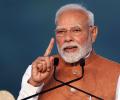
Prime Minister Narendra Modi on Friday said India will never compromise the interests of its farmers, fishermen and dairy farmers, asserting that he would be ready to pay any price.

In a double-dose bid to boost growth and employment prospects, the Union Cabinet on Tuesday approved a Rs 2.07 trillion outlay for a research development and innovation (RDI) Scheme to fund private sector innovations, and an employment-linked incentive (ELI) to create over 35 million new jobs over the next two years.

'The heat shield technology for re-entry vehicles was first mastered in DRDO for the Agni missile.' 'This is why the Americans were so opposed to Agni in the 1980s, unlike other missiles -- it was a re-entry vehicle.'

Any industrial policy is only as good as how it is applied and the other reforms that support it. This was as true 40 years ago as it is now, points out Debashis Basu.

'The scrapping of import duty would help Indian companies compete in international markets, thus paving the way for India becoming a space manufacturing hub for the world.'

Some of the suggested strategies include making thoughtful trade-offs between career choices and family responsibilities to avoid the guilt of not spending adequate time with elders and children at home; resisting the pressure to be a 'superwoman' by trying to manage everything alone; demanding, negotiating, and selecting jobs with flexible working hours; exploring work-from-home options; choosing an appropriate time for a career break; upskilling to re-enter the workforce after a break; and communicating openly with family members -- including spouse and in-laws -- about the support needed to grow professionally and the challenges faced at work, highlights N Ravichandran.
Prime Minister Narendra Modi on Wednesday urged all stakeholders to come together and invest in people for skill development, nurturing talent and promoting innovation which are essential for job creation and boosting the economy. Participating in post-Budget webinar on employment, Modi said the government has provided skill training to 3 crore youth since 2014 and decided to upgrade 1,000 ITIs and set up five centres of excellence.

Sitharaman said the government will bring in a new national education policy to transform India's higher education system into one of the best in the world.

India has its share of both large tech companies and large national laboratories, but why is it that these don't seem to be at the forefront of any innovation news headlines? asks Ajit Balakrishnan.

In the last budget, then finance minister Arun Jaitley had allocated Rs 85,010 crore for the education sector which was later revised to Rs 83,625.86 crore.

'The BJP's numbers in this government are almost the same as those enjoyed by the Congress under P V Narasimha Rao when the reform process was kicked off in 1991.' 'As before, the only constraints on the prime minister's actions are internal, not external.' 'They come from his own assessment of the political consequences of any action,' points out Mihir S Sharma.

The outfit suggested that the government amend the Information Technology Act to classify all such content as pornography, which people should only be able to access by punching in their Aadhaar details or their fingerprints. Archis Mohan reports

Dr Ajay Kumar Sood will have to complete a task his predecessor started: Getting the government to sign off on a new Science, Technology, and Innovation Policy on which work was begun in 2020.

We asked colleagues, present and past, to reflect on a man who has made such a difference to their lives and careers. Here it is then, a rich collection of memories that offer enchanting glimpses of the enigmatic Ajit Balakrishnan.


Prime Minister Narendra Modi on Wednesday inaugurated Abu Dhabi's first Hindu stone temple amid devotional chants and in the presence of spiritual leaders of the Swaminarayan sect.

Readers have responded resoundingly to our invitation to congratulate the ISRO team for Chandrayaan-3's successful Moon landing.

'A veiled secret of India's defence and strategic culture is the lack of a serious interest in them by the political class. The Indian National Defence University would fill this void,' feels Lieutenant General Anil Chait (retd).
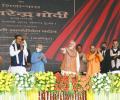
Any defeat for the BJP now would imply that anti-incumbency against Modi has set in, says N Sathiya Moorthy.

The procurement and distribution will be centralised though the government is yet to take a call on the initial number of doses that will be procured.

Stalin, like his father M Karunanidhi did in 2004, may play the king-maker in a way -- not the king, unless the 2024 post-poll circumstances throws up a situation where he alone becomes acceptable to the rest, observes N Sathiya Moorthy.
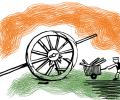
Pragmatism and flexibility is a virtue. An untethered and short-term approach to policymaking is a flaw, argues Mihir S Sharma.
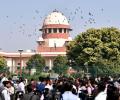
Tamil Nadu's unending legislative fight for exemption from NEET has now flagged the question if it's time to review the Supreme Court's famous verdict in the 'Mandal case', fixing 50-per cent upper-limit for all reservations, asks N Sathiya Moorthy.

The CDS has the option to focus on key areas of capability development to fight new generation wars or get bogged down in trying to bring cosmetic changes to humour the political leadership, asserts Brigadier Narender Kumar (retd).

Unless each attack drone can be neutralised, India will be literally deploying elephants to stamp out ants -- and the ants may still survive! points out N Sathiya Moorthy.

Indian elections are won and lost on 'negative' imageries and campaigns - but not certainly on 'negativity' as a political trait and electoral creed, asserts N Sathiya Moorthy.
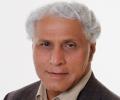
Wadhwani joined the billion-dollar club in 1999, when he sold a venture for $9.3 bn to i2 Technologies.
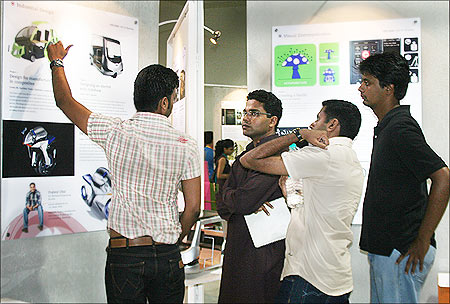
Perhaps, the most misunderstood aspect is the role of the state.

The real battle for NEET abolition can take much more time and energy, observes N Sathiya Moorthy.

Rup Narayan Das reveals the towering Odisha leader's role in improving national security after the 1962 War with China.
'The term 'pro-growth' must be qualified somewhat because, while a rising tide will lift all boats, it will not necessarily do so equally.'
 © 2026 Rediff.com - Advertise with us - Disclaimer - Privacy Policy - Sitemap - Feedback - About us - Terms of use - Grievances